What follows are some commonly used knife terms that you may find referenced in reviews and in knife discussions. You are welcome to suggest terms to be added to this dictionary by sending me an email or leaving a comment below.
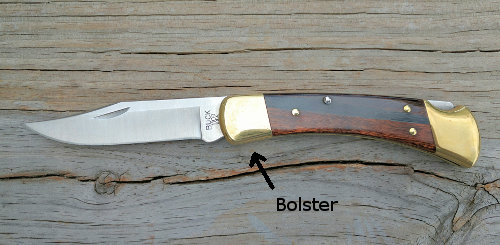
Bolster
Bolsters can be decorative and functional, depending on the context and application.
In the context of a fixed blade knife, the bolster refers to a band of metal between the blade and handle used to support (or “bolster”) the transition between blade and handle. Bolsters can aid in the balance of a fixed blade.
However, we often see bolsters on folding knives. These are typically decorative pieces used to embellish the handle and give the knife a certain look. You see this often on traditional knives. The Buck 110 is a classic example of a bolstered folding knife.
Choil
There are a couple definitions for a “choil”.
The first is what we sometimes refer to as a “finger choil”. A finger choil is a large un-sharpened part of the knife blade that is located at the ricasso: where the blade becomes part of the handle. Usually, this section is curved to accept the index finger. The Spyderco Lava below is an excellent example of a knife with a large finger choil.
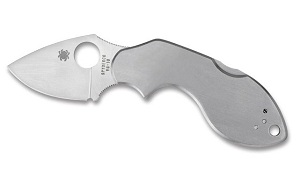
There is also something referred to as a “sharpening choil”. A sharpening choil is a small notch or relief at the end of the edge right next to the ricasso. This allows the user to sharpen the knife all the way to the heel of the blade. The Spyderco Lava also features a small sharpening choil right next to the finger choil.
EDC
EDC is an acronym for “Every Day Carry” and refers to an item that you carry with you every day for common tasks. An “EDC knife” refers to a knife you would carry every day. Here is a link to all of our reviews of EDC knives.
Fuller
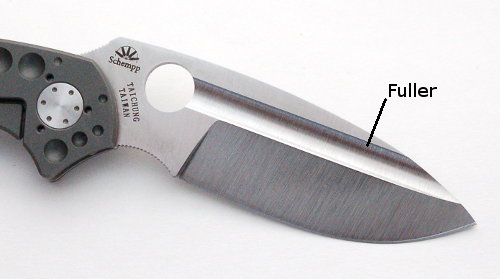
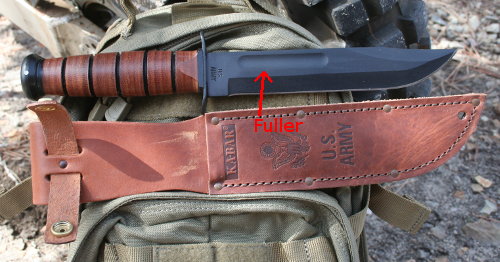
A fuller is a rounded or beveled groove or slot milled into the flat side of a blade. Sometimes these are referred to as “blood grooves”, but that term more of an embellishment then anything. Typically fullers are for decorative purposes, but in some cases they are used to lighten or balance a knife. A good example of a fuller would be the Spydero Tuff:
Another more traditional example of a fuller is with the Ka-Bar USMC knife:
Jimping
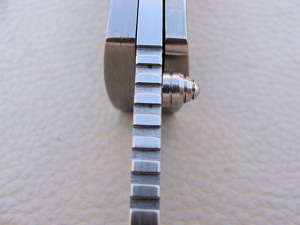
Small notches or filework cut into the back of a blade or put on the choil or other portions of the knife. Jimping is used to prevent your fingers from sliding when using the knife.
Quillion
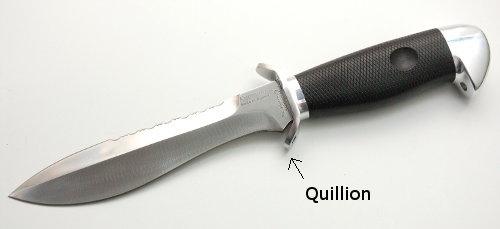
A quillion refers to the cross guard of a sword or knife. This is a protrusion from the handle designed to protect the hand of the user from sliding up the handle onto the edge of a knife, or to prevent another knife (or sword) from sliding down your blade onto your hand. Quillions are mostly found in self defense knives. A good example of a quillion can be found on the ROSarm’s Kisten:
Recurve
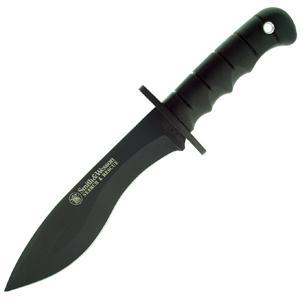
A recurve isn’t used to describe a specific blade shape. Instead, it is a feature on a blade, and many blade shapes can feature a recurve. A recurve generally refers to a blade with a sweeping, “S” shaped, edge. Recurves can be used to help balance a large chopping blade, provide better slicing ability to a blade, or simply enhance the look of a knife. This Smith and Wesson survival knife with a drop point blade is an excellent example of a knife with a recurve:
Ricasso
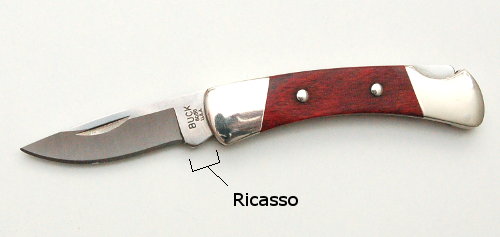
An unsharpened length of blade just above the handle or guard of a knife. Here is an example of a ricasso on a Buck 505:
Swedge
A term used to describe an un-sharpened bevel on the back of the blade. Sometimes referred to as a “false edge”. Swedges are largely decorative, but can be used to enhance the penetrating ability of a blade or lighten a blade slightly.
Tang / Full Tang
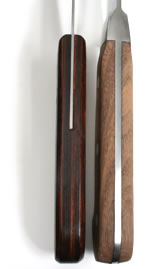
A tang is the protrusion of the blade steel into the handle of the knife. Below is a picture of the handle of 2 kitchen knives. The one on the right has a full tang while the one on the left has a partial tang. Generally speaking, a full tang knife will be stronger than a partial tang knife.
Blade Shapes
This section will cover basic blade shapes. I’ll add more and update this section as I have time.
Drop Point
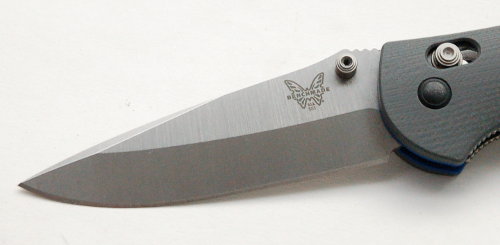
The drop point is the most common blade shape, and for good reason. The good ole drop point is simple, visually pleasing, and practical. You will be hard pressed to find a more useful all round blade shape, and it’s a more “socially acceptable” blade shape ideally suited for EDC knives.
A drop point blade features a spine that slopes from the handle of the knife to the tip of the blade. It drops down from the handle to the point, or tip of the blade, hence “drop point”. There are many variations on the drop point.
The G-10 Benchmade Griptilian is a popular knife with a classic drop point blade:
Here is a link to an in-depth article I wrote on drop point knives.
Clip Point
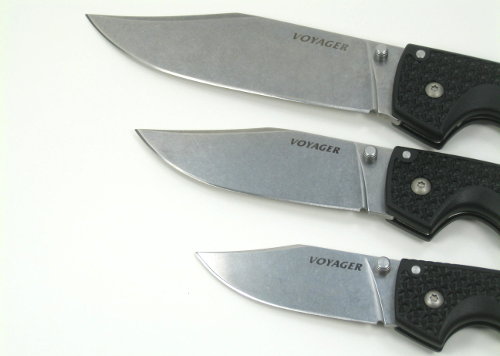
The clip point is probably the second most popular blade shape. It’s popularly referred to as a “bowie knife” and the names are more or less interchangable for this style of blade. A clip point blade has the appearance of the forward part of the blade being “clipped” off. This clip can be straight or curved. The end result is a knife with a distinct look.
The potential advantage to a clip point blade over a drop point is that it can have a finer tip for penetrating cuts, and in some cases it can offer more belly then a drop point.
One of my favorite clip point blades is the Cold Steel Voyager. Cold Steel offers a lot of clip point blades, as the founder is a fan of the design and they are a practical shape for tactical / defensive use if you know what you are doing. This goes back to the days of the wild west and Jim Bowie, who is credited for popularizing this style of blade.
Spear Point
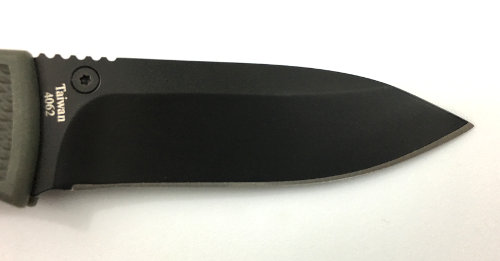
The spear point blade is a perfectly symmetrical profile designed to mimic the head of a spear. These are actually kind of tough to find in the production world, as technically a lot of them are actually drop points. They can be sharpened on both sides, but you won’t find many of those on the conventional knife market for obvious reasons (dangerous, impractical for utility work, and illegal in many jurisdictions).
The Ka-Bar Dozier Folding Hunter is a good example of a spear point. It may not be technically a spear point blade, I haven’t taken a micrometer to mine, but if it isn’t then it’s pretty darn close. You can see that the tip of the blade is about dead center, and the blade shape is pretty much symmetrical. Sort of like what you might find on a spear.
Wharncliffe
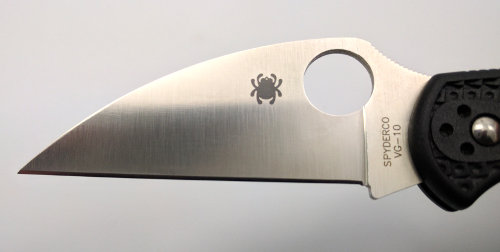
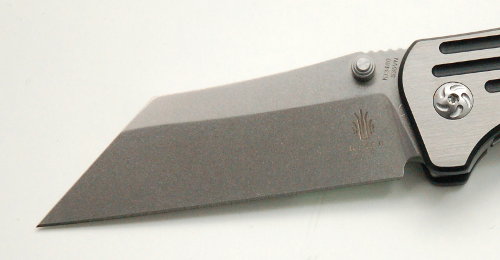
The wharncliffe blade features a perfectly flat edge. One way to think of it is a wharncliffe is like a box cutter. For those new to the hobby, it may take a while to warm up to the unique look of the wharncliffe, but it’s a highly functional blade shape that has a loyal following.
The Wharncliffe Delica 4 is good example of the style:
The Kizer Rogue is another more traditional example of a wharncliffe blade:
Sheepsfoot
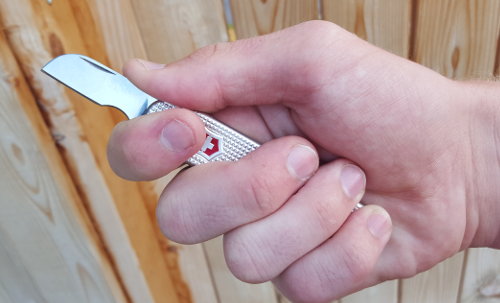
The sheepsfoot blade is a variation on the wharncliffe. It often has a straight edge (or a slight belly in some cases), but rather than having the fine tip of a wharncliffe, the tip is blunted. Historically, this blade shape was used to castrate sheep. You don’t want a sharp tip when you are trying to cut the balls off of a wriggling sheep. Not that I’m speaking from experience or anything.
I haven’t reviewed a lot of knives with sheepsfoot blades. They are relatively rare. But Grayson reviewed the Victorinox Electrician, and it’s a great example of a sheepsfoot blade. Here is a photo:
Tanto
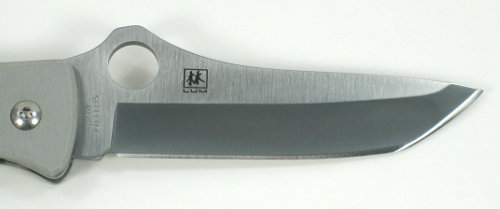
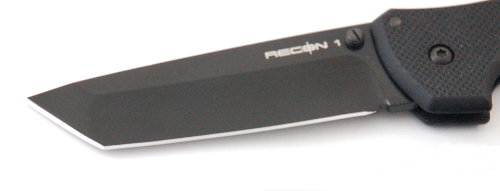
The tanto blade shape is a Japanese inspired knife pattern that reminds you of a traditional katana. Tanto blades have strong tips, which makes them great for piercing cuts, but they don’t have much belly so you may find them less practical for utility tasks like food prep.
I have always admired the beautiful tanto blade on the Spyderco Lum Tanto:
The Cold Steel Recon 1 is another example. This is a little less stylized then the Lum Tanto, and a better example of what to typically expect:
I wrote a more in-depth article about tanto blades if you want a deeper dive on the subject matter.
Reverse Tanto
The reverse tanto is a blade shape popularized by Warren Osborn. He is probably best known for his Benchmade 940, which is the quintessential reverse tanto. Here is a picture of my 940-1, the upgraded version of the 940 with carbon fiber handles and a S90V blade:
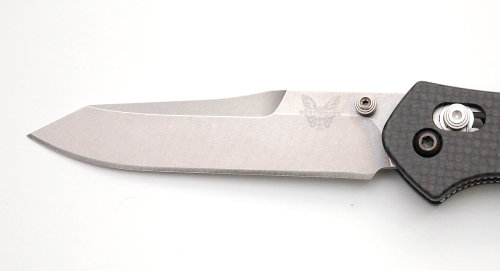
Essentially, the reverse tanto is a standard tanto flipped on its head, so the angled tanto tip is on the top side (the spine) of the knife. The edge is a traditional curved edge with some belly. It looks unique, may offer a stronger tip than a drop point, but still gives you some belly.
Knife Dictionary – Final Thoughts
This article continues to be a work in progress, thanks in part to some “encouragement” from the comments section. Honestly, I appreciate the tough love. It makes for a more thorough dictionary. Let me know if there is anything else you have a question about or want to see. I just may update this further!
Please bear with the new guy, but a brief description & pic of blade types would be good stuff for the dictionary (e.g. tanto, wharncliffe, onion, drop point, etc). Forgive me if that info is somewhere on the site already. But if not – and if you should have a chance to add it – then thank you much in advance.
Hi Adam,
Thanks for stopping by and for the excellent suggestion. I could probably knock something like this together fairly easy and it’s a great idea. I’ve been busy but I will put this on my to do list and try to put a page together.
Thanks again,
Dan
It’s 2015 and I dont see this chart yet….or did I just miss it?
This website is full of excellent info and I think a blade chart as requested would help newbies like myself.
Keep up the great work!
Haha, you got me. Never made it. Too many things to do, too little time. I agree it would be a great resource and I have been eyeballing a new table plugin so let me write a note to myself to try to work it into my schedule. Thanks for reminding me.
Dan
Lol, hilarious.
10 years later, people are still finding this information usefull. Thank you for a great informative article. I now know what Jimping is on my son’s old cub scout knife.
It’s interesting to see how often the word “swedge”, a malapropism for “swage” is used by well-meaning but uninformed knife forums, distributors, and even some knife makers these days. The term “swedge” was never used in reference to the fashioned curve on the spine or back of the tip of a knife before the internet, which unfortunately has allowed misinformation to be spread quickly and unchecked by other who assume all they read is accurate.
Nice to be able to find the meanings to lots of these terminologies. Thanks for your time in putting this together.
Another term I don’t know is what is trac-tec.
Fred,
I’m glad this has been helpful. Trac-tec is a rubberized plastic that Kershaw inlays into the handle of some of their knives for extra grip. It’s just pieces of rubber glued into the handles.
best,
Dan
Tis 2017. Still hadn’t been able to put up additional terms…in over 4 years?
What terms do you need to have defined? Busy cranking out a brand new review on a weekly basis.
Quillon, ricasso, serration, drop point, swage point, trailing point, tanto blade, fuller/cannelure, bolster, grind line, line cutter, milling, liner,
Wow! OK, thanks for the ideas. I’ll get to work on some definitions!
Detent
Also, what the first guy said is still a good idea.
Please bear with the new guy, but a brief description & pic of blade types would be good stuff for the dictionary (e.g. tanto, wharncliffe, onion, drop point, etc). [sic]
Hello,
Have you been able to make any headway?
I put choil into my search engine and found your site. I like it, thank you.
Thanks Murrell!
Dan
I’m a fan of sheepsfoot blades. I didn’t see them described he here.
Blaise,
OK – fixed! Added a section on sheepsfoot blades. Anything else?
Dan
Hah! Eric your comment was pretty funny. Frankly, you expressed my feelings far better than I could, but you know this was a page that needed updating, so I don’t necessarily mind the “nudges” from the reader. Anyhow, thanks for reading and taking the time out to leave a kind comment. I appreciate it!
Dan
This page answered my question (What is Jimping) and even made me think of other questions I didn’t know I needed answered.
Thanks Mike!!
Thanks, Mike! Glad it was helpful!
Dan
hi dan. what you call a choil in the example pic is actually the ricasso. the choil is that little nick right before the ricasso begins. i’m 50 percent sure of this.
Eric, You are right. There is something that’s informally called a “finger choil” on some knives, like the Lava. And then there is the sharpening choil. And then there is the unsharpened ricasso. I need to clarify this section. Thank you for pointing that out.
Dan
I saw in the first comment by “adam” from back in 2013, that the blade type “onion” was suggested. I have never heard this term before, and am not even sure that I’m correct in my assumption that it is a blade type. I would very much appreciate a definition and detailed description of the term “onion” as it applies to knives and / or blades. Thank you very much for your time and consideration!
Hi Amanda,
Thanks for stopping by. I have never run across a term for an “Onion” blade shape. I don’t think such a term exists, unless you are generally describing the curvy/flowy lines of a blade designed by Ken Onion. He is known for recurves and an organic style that many will recognize.
Best,
Dan
GREAT STUFFD MAN!!
Thanks for the info and time!!
What about an article about various grips on the handle of the knife and their Pros and Cons?
Thanks for a wealth of new Scrabble words!! I needed the definition of a knife term (the oft sought “choil”) and found a wealth of new Scrabble possibilities!! Thanks for the effort to pull this all together in one place!! —Kate